
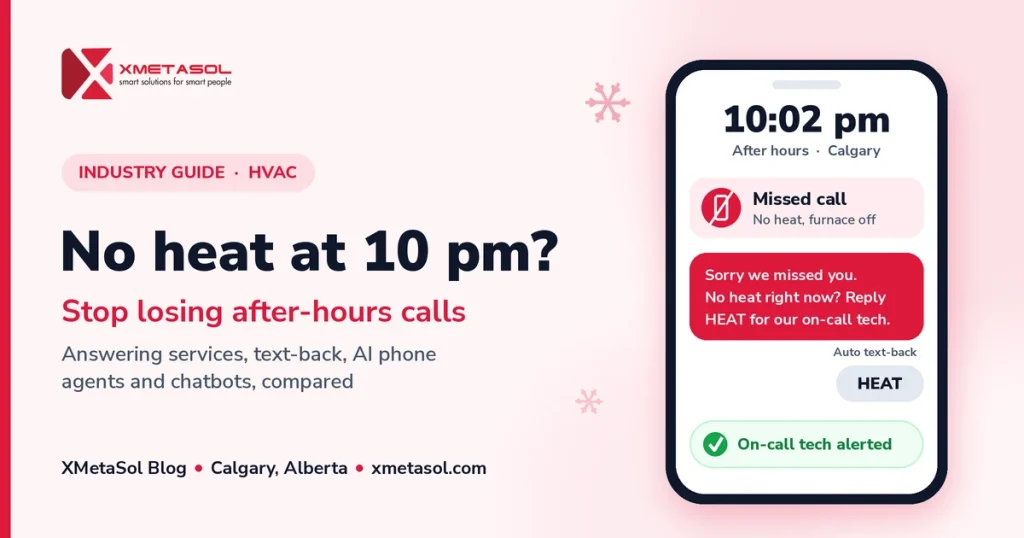
When a furnace stops on a January night in Calgary, the homeowner doesn’t wait for your office to open. They pick up their phone, search for furnace repair and start calling. If your line goes to a full voicemail box or rings out, the next company on the list gets the job, and you may never know the call happened.
This guide is for Calgary heating and cooling companies weighing an HVAC answering service, automation or both. We’ll map what happens to a missed call, compare four ways to cover the phones, and make sure a real emergency still reaches a real technician. We finish with the privacy rules that apply and a setup checklist.
Why after-hours calls matter most in a Calgary winter
Calgary’s heating season is long. In Environment and Climate Change Canada’s 1981–2010 climate normals for the Calgary airport station, the average daily temperature is below freezing in every month from November to March, and January averages about −7 °C (Canadian Climate Normals). Cold snaps go well below those averages. For about five months a year, a furnace that stops can’t wait until Monday.
A caller with no heat is usually ready to book and may become a long-term maintenance customer. These calls also arrive at the worst time for a small team: the office is closed and the on-call tech may already be on another job.
What happens to a missed call today
Before you pick a fix, call your own business number from a cell phone at about 9:30 pm and write down each step:
- Rings: How many before something happens? Voicemail, a forwarding number or nothing?
- Greeting: Does it say what to do in an emergency, or just “leave a message”?
- Voicemail: Is the box full? Who listens to messages, and when: tonight or at 8 am?
- Callback: Does anyone call or text back, and how soon? Or does it depend on who happens to be awake?
- Record: Is the missed call logged somewhere you can count later?
Then search your business name on Google and check the hours and phone number on your Business Profile. Our Google Business Profile checklist for contractors walks through those fields. Google also lets you set special hours for holidays (Google Business Profile Help), which matters over Christmas, when cold weather and closed offices overlap.
Finally, start a weekly count of missed after-hours calls. A number on a whiteboard is enough to tell you whether the problem is two calls a week or twenty, and whether your fix is working.
Option 1: an answering service
A traditional answering service puts a live person on your line when you can’t answer. They follow your script, take the caller’s details and pass the message to your on-call tech by text, email or phone.
Where it works well: a stressed, cold caller hears a human voice, and the setup is easy to explain to your team.
What to check before you sign up:
- Booking: Can the operator book into your schedule, or only take a message?
- Emergency rules: Will they follow your written rules (see the routing section below) rather than their own judgement?
- Hand-off: How fast do messages reach your on-call tech, and what happens if the tech doesn’t respond?
- Service area: Do they know where you don’t go, so nobody promises a visit you can’t make?
- Quality: Can you hear sample calls?
Ask for a written quote based on your actual after-hours volume, which is another reason to count your missed calls first.
Option 2: missed-call text-back by SMS or WhatsApp
Missed-call text-back is the simplest fix here. When a call goes unanswered, the caller automatically gets a text, for example: “Sorry we missed your call. This is [Company]. If you have no heat right now, reply HEAT and our on-call tech will be alerted. Otherwise reply with your address and a good time to call, and we’ll get back to you in the morning.”
It turns a dead end into a conversation. Replies can go straight to whoever is on call, and everything is in writing, so nothing gets lost before the office opens.
SMS or WhatsApp? SMS works on every phone and is the safe default. WhatsApp can be a good second channel, but it has its own rules. WhatsApp’s Business Messaging Policy says a business may only contact people who have given it their phone number and have opted in to hear from it. On the WhatsApp Business Platform, free-form replies are allowed within a 24-hour customer service window after the customer’s last message (WhatsApp Business Messaging Policy). So the simplest approach is a WhatsApp link in your text-back or on your website, so the customer starts the chat.
Keep it about their request. Under Canada’s Anti-Spam Legislation (CASL), a text sent to a phone is an electronic message, and if one of its purposes is to promote something, it’s a commercial electronic message that needs consent, identification of the sender and a way to unsubscribe (CRTC CASL FAQ). A text-back that only helps with someone’s call is different from a promotion, so don’t add a tune-up special to it. More on consent below.
Option 3: an AI phone answering agent
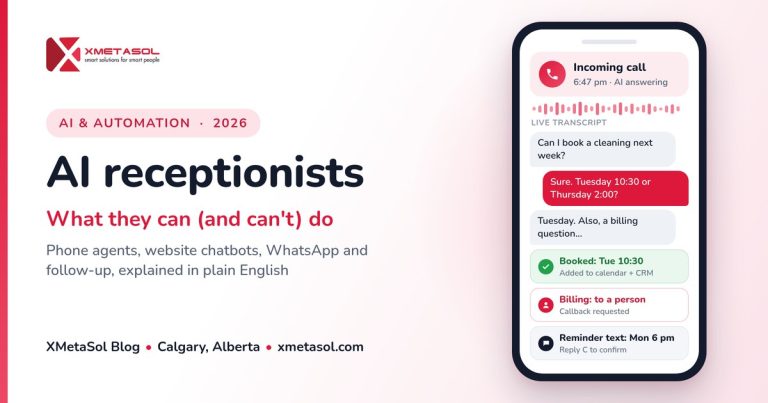
An AI phone answering agent picks up the call and talks with the caller in ordinary conversation, asking follow-up questions rather than reading a menu. A well-built agent for an HVAC company can:
- Ask your dispatcher’s questions: no heat or low heat, furnace or boiler, any gas smell or carbon monoxide alarm, address and callback number.
- Book a visit into your calendar or job-management tool when the job can wait until morning.
- Take a message and send it to the right person by text or email, with a short summary.
- Hand off to a human right away when something is urgent or the caller asks for a person.
Be clear about the limits. An AI agent shouldn’t diagnose a furnace or give safety advice beyond a short script you’ve approved. It can mishear addresses, so it should read key details back. Its job is to make sure nobody hangs up without being looked after, not to replace your technicians. Before it goes live, test it with realistic calls: a panicked caller, a bad cell connection, someone who only wants a quote.
Adoption is growing, though construction businesses lag. In Statistics Canada’s survey for the second quarter of 2025, 12.2% of businesses said they had used AI to produce goods or deliver services in the previous 12 months, up from 6.1% a year earlier. Among those businesses, virtual agents or chatbots were used by 24.8% and speech or voice recognition by 20.0%. Only 9.6% of construction businesses said they planned to adopt AI software in the next 12 months, compared with 17.9% of all businesses (Statistics Canada).
Option 4: a website AI chatbot for after-hours enquiries
Not everyone calls. Some homeowners land on your website late at night and want help without talking to anyone. A website chatbot can answer common questions (which areas you serve, whether you work on boilers, what happens on a no-heat visit), collect contact details and a description of the problem, offer a booking slot, and show your emergency number when something is urgent.
It works best next to a clear phone number and a WhatsApp option, not instead of them, and it should say plainly that it’s automated. If your site is slow on a phone, fix that first: a chatbot can’t help visitors who leave before the page loads. Our guide to what a website costs in Calgary explains how features like online booking and chat change a site’s scope, and our website development page covers how we build them.
Routing true emergencies to an on-call tech
Whatever tools you choose, write down what counts as an emergency and what happens next, and make every tool follow the same rules. For example:
- Smell of gas: the caller is told to leave the building right away and call 911 or ATCO’s gas emergency line (1-800-511-3447) once they’re outside. That’s what the City of Calgary advises for a suspected gas leak (City of Calgary). Never a booking.
- Carbon monoxide alarm sounding: the caller is told to leave the home, get to fresh air and call 911 from outside, as Health Canada advises (Health Canada).
- No heat, with very cold weather or vulnerable people in the home (babies, older adults, someone unwell): straight to the on-call tech’s phone, with a written summary.
- No heat in milder weather, or reduced heat: the on-call tech gets a text and decides, and the caller is told when to expect a call back.
- Everything else (quotes, maintenance, thermostat questions, new installs): booked for the next business day or logged for a morning callback.
Rotate the on-call phone fairly and name a backup if the first person doesn’t respond within a set time. Automation passes messages quickly, but a person still has to answer them.
Consent, call recording and privacy basics (CASL, PIPA)
After-hours systems collect names, addresses, phone numbers and sometimes details about who is in the home. This is general information, not legal advice.
Alberta’s PIPA. Private businesses in Alberta handle personal information under the Personal Information Protection Act (PIPA) (OIPC Alberta). The Government of Alberta explains that you can only collect personal information for reasonable purposes and only as much as you reasonably need. Before or while collecting it, you must say why you’re collecting it and give the name or title of someone who can answer questions (Government of Alberta). If a service provider outside Canada collects it, which is common with phone and AI tools, you must also tell people how to find your policies on that provider. Keep the information secure and only for as long as you reasonably need it (Government of Alberta).
Recording and transcripts. If calls are recorded, or an AI agent keeps transcripts, tell callers at the start and say why. The Office of the Privacy Commissioner of Canada’s guidance on recording customer calls says the purpose should be stated as clearly and narrowly as possible, and that if a caller carries on knowing the call is recorded and why, consent is usually implied. It also says callers should have an alternative if recording isn’t essential to the service (Office of the Privacy Commissioner of Canada). It’s written for businesses under the federal law, PIPEDA, and the OPC calls it best practice for others, so it’s a sensible standard under PIPA too.
CASL and texts. Promotional texts need consent, must identify the sender and must offer an easy unsubscribe, such as replying STOP. Pre-checked boxes don’t count as express consent, the sender has to prove consent, and the CRTC suggests asking for express consent when you’re unsure (CRTC CASL FAQ). Keep missed-call texts about the customer’s request, and ask separately before sending seasonal offers.
A simple setup checklist
- Call your own number after hours and write down what a caller experiences.
- Start a weekly count of missed after-hours calls.
- Rewrite your greeting so it says what to do in an emergency and when people will hear back.
- Check your Google Business Profile hours and phone number, and set special hours for holidays.
- Turn on missed-call text-back by SMS as a minimum, with a WhatsApp link if your customers use it.
- Choose a live answering service, an AI phone answering agent or a mix, and test it on yourself first.
- Add a website chatbot if many enquiries arrive through the site after hours.
- Write down your emergency rules and on-call rotation, with a backup person.
- Add a privacy and recording notice, and keep marketing texts separate from replies.
- Review your missed-call count after the first cold month and adjust.
How XMetaSol can help
We build the tools described in this guide for local service businesses: AI phone answering agents that answer calls, book appointments and take messages; missed-call text-back over SMS and WhatsApp; website chatbots; and lead follow-up that connects them to your calendar or job-management tool. Each is set up around your questions, service area, hours and emergency rules, with a clear hand-off to a person. You can read more on our AI solutions page, or see how we work with heating and cooling companies on our HVAC marketing page. Roofers face the same problem on storm days, which we cover on our roofing marketing page.
Sources
- Environment and Climate Change Canada, “Canadian Climate Normals 1981–2010: Calgary Int’l A” (mean daily temperature by month): climate.weather.gc.ca
- Google Business Profile Help, “How to set Special hours”: support.google.com
- WhatsApp, “WhatsApp Business Messaging Policy”: business.whatsapp.com
- CRTC, “Frequently Asked Questions about Canada’s Anti-Spam Legislation”: crtc.gc.ca
- Statistics Canada, “Analysis on artificial intelligence use by businesses in Canada, second quarter of 2025” (16 June 2025): statcan.gc.ca
- City of Calgary, “What to do during a utility outage” (gas leak guidance): calgary.ca
- Health Canada, “Carbon monoxide: Preventing exposure”: canada.ca
- Office of the Information and Privacy Commissioner of Alberta, “Personal Information Protection Act (PIPA)”: oipc.ab.ca
- Government of Alberta, “Collecting personal information”: alberta.ca
- Government of Alberta, “Organization responsibilities for protecting personal information”: alberta.ca
- Office of the Privacy Commissioner of Canada, “Recording of Customer Telephone Calls”: priv.gc.ca

Pingback: AI Receptionist for Small Business: What It Can (and Can’t) Do in 2026 | XMetaSol